48V vs 51.2V LiFePO4 Battery: Which Is Better for Solar Storage?
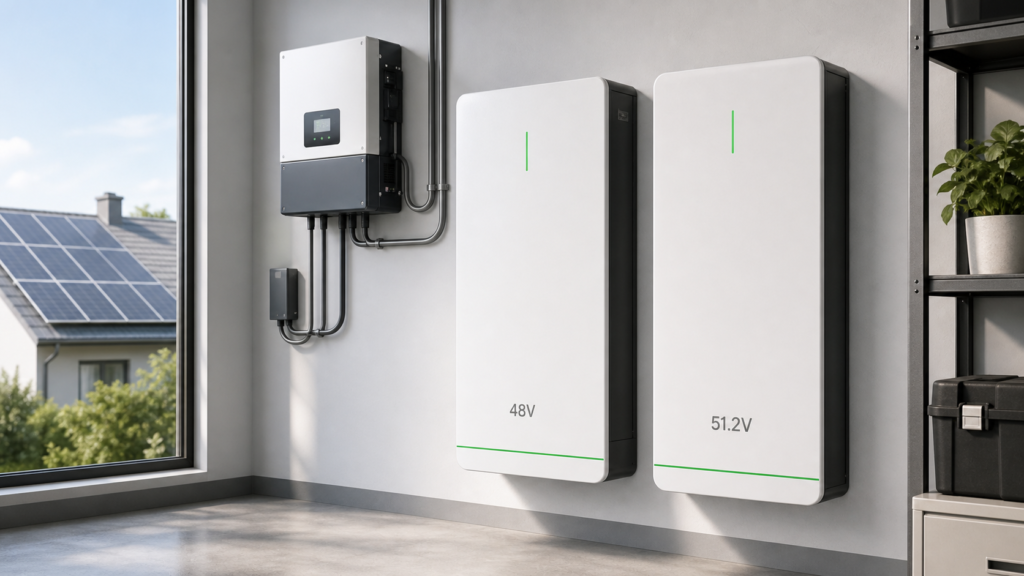
For many solar energy storage projects, buyers compare 48V and 51.2V LiFePO4 batteries because both are commonly used with residential and light commercial hybrid inverters. At first glance, the difference looks small. In real system design, however, 51.2V has become a practical standard for many modern lithium battery packs because it matches a 16-cell LiFePO4 configuration and provides a clear voltage platform for solar storage.
This guide explains the difference between 48V and 51.2V LiFePO4 batteries, how they affect usable energy, inverter matching, BMS selection and long-term expansion, and how buyers can choose the right option for a solar storage project.
What does 48V mean in a solar battery system?
In the solar storage market, “48V battery” is often used as a general system category rather than one exact voltage. Many lead-acid battery banks are called 48V systems because they use four 12V batteries in series. Their actual voltage changes significantly during charging and discharging.
For lithium batteries, the nameplate voltage depends on the cell chemistry and cell count. A LiFePO4 cell has a nominal voltage of about 3.2V. When 16 cells are connected in series, the pack nominal voltage becomes 51.2V.
That is why many modern solar storage batteries are marked as 51.2V, even though they are still compatible with many inverters that are described as 48V systems.
48V vs 51.2V: the key difference
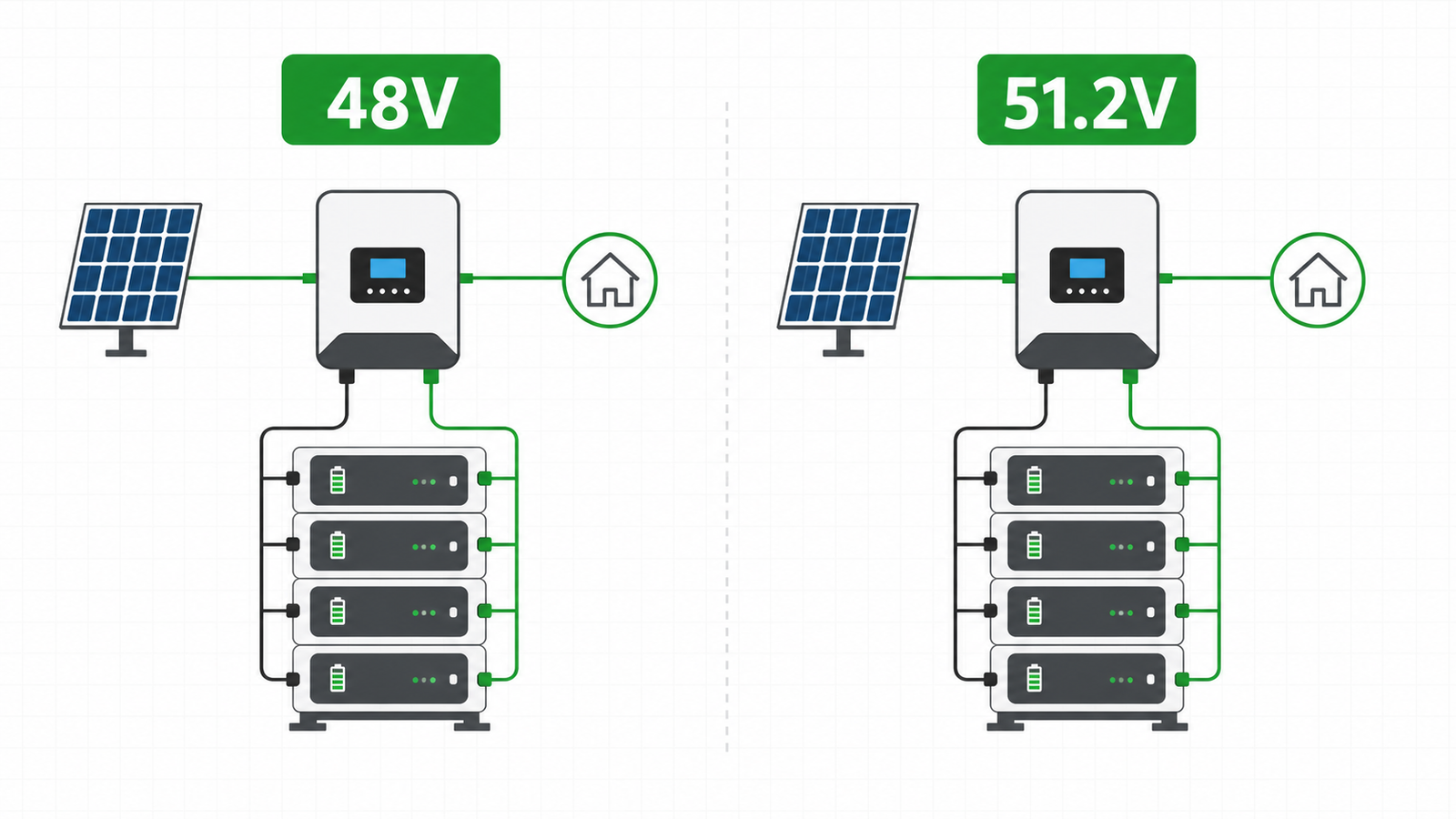
The main difference is nominal voltage and cell configuration. A 51.2V LiFePO4 battery normally uses 16 cells in series. This gives the battery a stable operating range that works well with many low-voltage hybrid inverters designed for 48V-class battery input.
| Battery specification | Nominal energy |
|---|---|
| 48V 100Ah | 4.8 kWh |
| 51.2V 100Ah | 5.12 kWh |
| 51.2V 200Ah | 10.24 kWh |
| 51.2V 314Ah | 16.08 kWh |
Why 51.2V LiFePO4 batteries are common for solar storage
There are several reasons why 51.2V LiFePO4 batteries are widely used in solar storage projects. The 16S LiFePO4 structure is mature and widely supported. It offers a practical voltage window for low-voltage inverters while keeping system design simpler than high-voltage battery stacks.
51.2V also makes energy calculations more transparent. A 100Ah battery stores about 5.12kWh nominal energy, while a 200Ah battery stores about 10.24kWh. For buyers comparing different wall-mounted, rack-mounted or stacked systems, this makes it easier to estimate backup time and system expansion.
For deeper sizing logic, see our guide on how to size a LiFePO4 battery for solar energy storage.
Inverter compatibility matters more than the name
When choosing between 48V and 51.2V, buyers should not rely only on the battery name. The inverter’s battery input range must match the real charging and discharging voltage of the battery pack.
- Battery nominal voltage
- Maximum charge voltage
- Recommended charge voltage
- Discharge cut-off voltage
- Maximum continuous charge and discharge current
- CAN or RS485 communication support
- Inverter brand and model compatibility
- Parallel connection limits
A 51.2V LiFePO4 battery can work very well with a 48V-class inverter when the voltage range and BMS communication are matched correctly. Problems usually happen when buyers only check “48V” on the inverter label and ignore the detailed voltage window or communication protocol. You can read more in our guide to LiFePO4 battery and hybrid inverter compatibility.
Which is better for home solar storage?
For most modern home solar storage projects, a 51.2V LiFePO4 battery is usually the better choice because it reflects the standard 16S LiFePO4 pack configuration and offers clear kWh calculations.
- 51.2V 100Ah battery for small backup needs
- 51.2V 200Ah battery for daily solar self-consumption
- 51.2V 280Ah or 314Ah battery for longer backup time
- Multiple parallel batteries for future expansion
If the project needs a neat residential installation, buyers can compare wall-mounted, rack-mounted and stacked LiFePO4 batteries based on available space, service access and expansion needs.
When should buyers still consider 48V batteries?
Some buyers still use the term 48V because their inverter, market or project documents are based on 48V-class systems. This is normal. In many RFQs, “48V lithium battery” may actually refer to a 51.2V LiFePO4 battery.
- A 16S LiFePO4 battery with 51.2V nominal voltage
- A different lithium chemistry
- A legacy replacement for lead-acid systems
- A custom voltage design for a special inverter or device
BMS current and usable capacity are critical
Voltage is only one part of battery selection. A good solar storage battery also needs the correct BMS current rating. For example, a 5kW inverter on a 51.2V battery system may require close to 100A from the battery side under high load. If the battery BMS current is too low, the system may shut down during peak loads even if the battery capacity looks sufficient on paper.
For larger capacity designs, our article on how to choose a 51.2V 314Ah LiFePO4 battery explains the selection points in more detail.
48V vs 51.2V: quick buyer recommendation
If you are buying batteries for a new solar storage project, 51.2V LiFePO4 is usually the stronger choice because it is widely used, easy to calculate, and compatible with many 48V-class hybrid inverters when the voltage range and communication protocol are correct.
For importers, distributors and project developers, the best RFQ should include inverter brand and model, required battery capacity in kWh, backup load power, application scenario, installation method, communication protocol requirement, certification and shipping requirements.
Explore our LiFePO4 battery products or request a quote if you need a 48V-class or 51.2V LiFePO4 battery solution for solar energy storage.
FAQ
Is a 51.2V LiFePO4 battery the same as a 48V battery?
Not exactly. Many people use 48V as a general category for low-voltage battery systems. A 51.2V LiFePO4 battery usually means a 16S pack made from 3.2V LiFePO4 cells. It is often compatible with 48V-class inverters, but the voltage range must be checked.
Can I use a 51.2V LiFePO4 battery with a 48V inverter?
In many cases, yes. Many hybrid inverters designed for 48V lithium batteries can work with 51.2V LiFePO4 packs. Buyers should confirm the inverter’s charge voltage, discharge voltage range, current limit and CAN or RS485 communication compatibility.
Is 51.2V better than 48V for solar storage?
For modern LiFePO4 solar storage, 51.2V is often preferred because it reflects a standard 16S LiFePO4 configuration and provides clear kWh calculations. However, the best choice depends on inverter compatibility, BMS current, application and installation requirements.
How many kWh is a 51.2V 100Ah LiFePO4 battery?
A 51.2V 100Ah LiFePO4 battery stores about 5.12kWh of nominal energy. Usable energy depends on depth of discharge, inverter efficiency and system settings.
What should I send to a manufacturer before ordering?
Send the inverter model, required capacity, backup load, installation environment, communication protocol, certification needs and target quantity. This helps the manufacturer recommend the correct battery voltage, BMS current and enclosure type.